Quanto for 2D Drawings: Create Priced BOQs Without a BIM Model
Concolabs Editorial
Concolabs Editor

Quanto for 2D Drawings: Create Priced BOQs Without a BIM Model
Many construction projects never produce a coordinated 3D model. Contractors and quantity surveyors may receive only PDF plans, DXF drawings, or legacy 2D information. Preparing a Bill of Quantities from those files often requires manual scaling, measurement, classification, rate lookup, and spreadsheet entry.
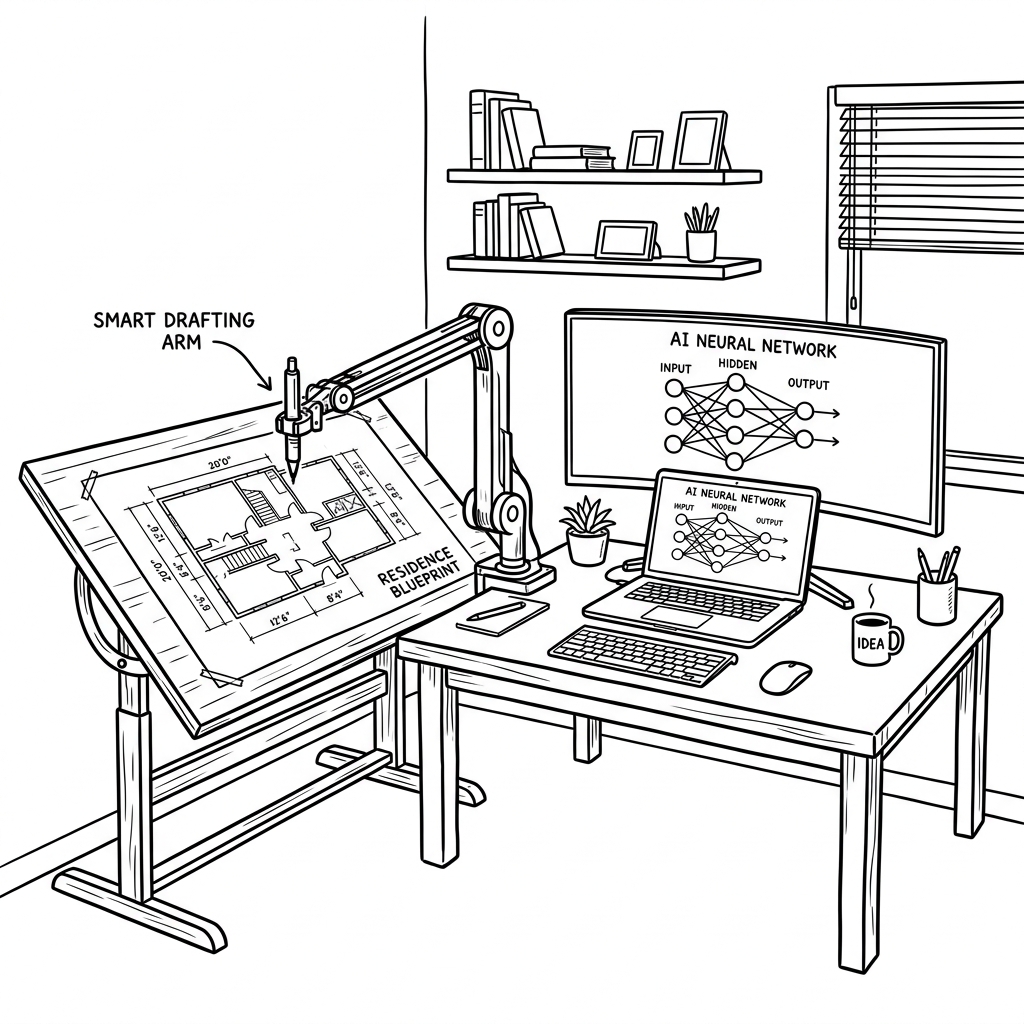
Quanto for 2D Drawings applies computer vision to flat drawings. It identifies building elements in PDF or DXF files, groups them under measurement rules, predicts line-item rates from the firm's historical pricing, and produces a formatted priced BOQ for expert review.
No BIM model is required. This makes automated quantity takeoff available to projects where the design information remains two-dimensional.
Key takeaways
- Quanto reads 2D PDF and DXF construction drawings.
- DXF provides the most reliable input; PDF is supported on a best-effort basis.
- Computer vision identifies and groups construction elements.
- AI predicts rates using the firm's historical pricing information.
- Concolabs currently lists the custom/R&D product at USD $900 per month, subject to confirmation.
What is Quanto for 2D Drawings?
Quanto for 2D Drawings is an AI-assisted quantity takeoff and pricing workflow for projects without a 3D BIM model. It reads information from flat construction drawings and carries the identified elements through measurement, rate prediction, and BOQ production.
The product is designed for contractors and QS firms working across the Middle East, Sri Lanka, and Australia. Concolabs currently identifies it as a custom/R&D offering, which means buyers should discuss drawing types, scope, expected outputs, and implementation requirements before deployment.
The 2D edition uses the same Quanto rate-prediction engine available for Revit, Autodesk Construction Cloud, and CostX workflows. The difference is the source: computer vision interprets drawing geometry instead of reading model objects or workbook items.
Why do 2D drawing takeoffs remain difficult?
A flat drawing doesn't contain the structured objects available in a BIM model. The estimator must interpret lines, annotations, symbols, dimensions, layers, scales, and details before deciding what each element represents.
Information quality also varies. A clean vector DXF may preserve geometry and layers. A PDF may contain vectors, raster scans, mixed scales, faint linework, overlapping notes, or pages copied from different sources. Some files are only photographs of printed drawings.
Revision control adds another risk. If several versions circulate through email, the estimator may measure a superseded sheet. Manual takeoff then hides the connection between the quantity, its location, and the source drawing.
Quanto reduces repetitive interpretation and measurement. The QS still verifies the drawing set, scale, coverage, assumptions, and automated results.
How does Quanto for 2D Drawings work?
The Quanto for 2D Drawings workflow follows four main stages.
1. Upload a PDF or DXF drawing
The user uploads the controlled 2D drawing set. Computer vision begins identifying relevant building elements from the flat information.
Concolabs states that DXF provides the most reliable read. PDF is supported on a best-effort basis. The distinction should be included in project planning because file type and quality can affect the review effort.
2. Identify and group the building elements
Quanto groups identified elements according to standard measurement rules. Concolabs lists NRM2 and other firm-specific measurement standards within the wider Quanto engine.
Elements that cannot be interpreted confidently should be flagged. A forced classification may be more dangerous than a visible exception because it can produce a plausible but incorrect quantity.
3. Predict the line-item rates
The AI rate engine maps historical pricing to the identified work items. Predictions use the firm's own pricing records rather than requiring repeated manual searches through previous bills.
The estimator still assesses whether the rate suits the project's date, location, specification, scale, procurement method, and commercial conditions.
4. Produce the priced BOQ
Quanto generates a fully formatted priced Bill of Quantities for expert review. The QS checks the measured quantities, descriptions, units, rates, exclusions, scope gaps, and totals before the document is issued.
Concolabs lists Excel and CSV exports, with output to specialist BOQ software where required.
Is DXF better than PDF for automated quantity takeoff?
Yes, DXF is the preferred input according to the product page. DXF files can preserve vector geometry, layers, coordinates, and object relationships more consistently than many PDFs.
PDF quality varies significantly. A digitally generated vector PDF may support reliable detection. A low-resolution scan, distorted photograph, or flattened drawing with heavy annotations may require more manual correction.
Teams should classify their usual files before implementation:
- Native vector DXF drawings
- Vector PDFs exported from design software
- Mixed vector-and-raster PDFs
- Scanned printed drawings
- Photographs of drawings
- Marked-up or heavily annotated sheets
- Multi-scale layouts and detail sheets
A pilot should test each important category. Results from one clean drawing shouldn't be assumed to represent the complete project portfolio.
What drawing-quality checks should happen before upload?
Automated takeoff works best when the source is controlled and readable. Before uploading, confirm:
- Drawing number, title, and current revision
- Scale and drawing units
- Completeness of the sheet set
- Legibility of lines and dimensions
- Availability of legends and schedules
- Consistency between plans, sections, and details
- Overlapping or duplicated geometry
- Referenced external files and missing layers
- Areas marked not for construction
- Design options, phases, and demolition scope
Where scale is uncertain, the estimator should calibrate against a known dimension. Missing sheets and unresolved revisions should be recorded as assumptions rather than hidden inside the output.
What are the benefits of 2D drawing-to-BOQ automation?
The main benefit is access. Teams can automate more of the takeoff process without waiting for a coordinated 3D model.
Potential operational benefits include:
- Faster first-pass quantity extraction
- Less repetitive tracing and spreadsheet entry
- Improved consistency across similar drawings
- Earlier identification of ambiguous elements
- Reduced manual historical-rate lookup
- A repeatable path from drawing to priced BOQ
- Clearer focus on exceptions and professional review
- Support for legacy and non-BIM projects
The value depends on drawing quality and project type. The goal is not to claim that every line can be interpreted perfectly. It is to reduce routine work while making uncertainties visible.
Does Quanto replace quantity surveyors or estimators?
No. Quanto supports quantity surveyors by automating repetitive identification, measurement, and rate mapping. Professional responsibility remains with the estimator or QS issuing the document.
The review should cover:
- Drawing completeness and revision status
- Scale, units, and calibration
- Measurement rules and classifications
- Duplicate or missing elements
- Openings, overlaps, and hidden scope
- Items shown only in notes, details, or schedules
- Historical-rate relevance and adjustments
- Preliminaries, risk, contingency, and provisional work
- Low-confidence detections
- Final BOQ descriptions, totals, and issue status
Automation is most useful when it directs expert attention to uncertainty instead of hiding it.
How does Quanto for 2D Drawings compare with BIM-based Quanto workflows?
Quanto for Revit reads model information through a native Revit workflow. Quanto for ACC connects to Autodesk Construction Cloud. Quanto for CostX reads measured workbook items. Quanto for 2D Drawings interprets PDF or DXF files through computer vision.
All four workflows share the Quanto rate-prediction engine and priced BOQ objective. The right input depends on the project's controlled source information.
If the team needs a 3D model rather than only a BOQ, Concolabs also offers Auto Conversion 2D to 3D. That product is intended to create BIM geometry from drawing information, while Quanto focuses on measurement and pricing.
Can poor-quality drawings or hand sketches be used?
Poor drawing quality increases uncertainty. A clean DXF is the preferred input, while PDF processing is offered on a best-effort basis. Scans, photographs, faint lines, skewed pages, handwritten notes, and uncertain scales may require significant manual review.
Hand sketches aren't the primary input described for Quanto. Concolabs provides a separate Hand Drawn to AutoCAD workflow for converting photographed sketches into cleaner CAD information.
Where the source is weak, a sensible process is to improve or convert the drawing first. The cleaner output can then support measurement and pricing more reliably.
What does Quanto for 2D Drawings cost?
As of August 2026, the Quanto for 2D Drawings product page displays a monthly subscription price of USD $900 for the computer-vision drawing-read and rate-prediction module.
The page also says that pricing should be confirmed before publishing. Buyers should verify current subscription terms, supported drawing types, customization, onboarding, training, data preparation, taxes, and regional availability directly with Concolabs.
An enterprise add-on is available as a custom plan for multi-office deployment and more complex proprietary historical-rate training.
How should a firm pilot Quanto for 2D Drawings?
Choose a completed project with controlled 2D files and an approved quantity takeoff. Include several drawing types so the test reflects normal work rather than only the cleanest sheet.
Upload the files and compare automated results with the approved benchmark. Review accuracy by element and work section. Record omissions, duplicates, incorrect classifications, scale problems, and low-confidence detections.
A useful pilot should measure:
- Drawing-upload and calibration success
- Element-detection accuracy
- Quantity agreement by work section
- Difference between DXF and PDF results
- Relevance of predicted historical rates
- Number of items requiring manual intervention
- Time required for expert review
- Export and BOQ-template compatibility
- Handling of drawing revisions
- Traceability from BOQ item to drawing location
Define acceptance thresholds before the test. A correct total can hide offsetting errors, so item-level review is essential.
Frequently Asked Questions
Does Quanto for 2D Drawings require a BIM model?
No. The product is specifically designed to read 2D PDF or DXF construction drawings. It identifies building elements, applies measurement rules and rates, and produces a priced BOQ without requiring a 3D model.
Which file type provides the most reliable result?
Concolabs states that DXF provides the most reliable read. PDF is supported on a best-effort basis. Actual performance depends on geometry, scale, resolution, annotations, layer structure, and drawing completeness.
Can the AI rate prediction adapt to our firm's historical pricing?
Yes. Quanto is trained on the firm's historical rate data before deployment. Clean descriptions, units, dates, locations, specifications, and accepted-rate records help produce more relevant pricing suggestions.
What measurement standards are supported?
The Quanto engine supports NRM2 and other measurement standards. Elements can be grouped and measured according to the firm's rules. Confirm any regional or client-specific requirements during configuration.
Does Quanto replace estimators?
No. It reduces repetitive drawing interpretation, measurement, and rate lookup. Estimators remain responsible for drawing validation, scope, measurement decisions, pricing context, risk, and final BOQ approval.
Can the final BOQ be exported to Excel?
Yes. Concolabs lists Excel and CSV exports, along with output to specialist BOQ software. Firms should test exact template, coding, and formatting requirements during the pilot.
What happens when drawing quality is poor?
Poor-quality drawings can reduce detection accuracy and increase manual review. Confirm scale, improve legibility, use the cleanest available source, and treat unclear elements as exceptions rather than assuming the output is complete.
Can Quanto read a hand-drawn sketch?
Hand sketches aren't the primary input described for Quanto. Concolabs offers Hand Drawn to AutoCAD for converting sketches into CAD information. That cleaned output may provide a more suitable basis for later takeoff.
How much does Quanto for 2D Drawings cost?
The product page currently displays USD $900 per month but asks users to confirm the price before publishing. Contact Concolabs through the Quanto for 2D Drawings page for current terms.
Create a priced BOQ even when the project has no model
Quanto for 2D Drawings extends quantity takeoff automation to the large number of construction projects that still rely on flat information. It combines computer-vision element detection, measurement rules, historical rate prediction, and priced BOQ production.
The professional review remains essential, particularly for PDFs, scans, incomplete sets, and unusual details. Used with controlled drawings and clear acceptance rules, the product can reduce repetitive takeoff work and give quantity surveyors more time for commercial analysis.
Explore Quanto for 2D Drawings or review the complete Concolabs product suite to compare every Quanto input workflow.