Natural Language BIM AI Modeling: Prompt-Driven Design
Concolabs Editorial
Concolabs Editor

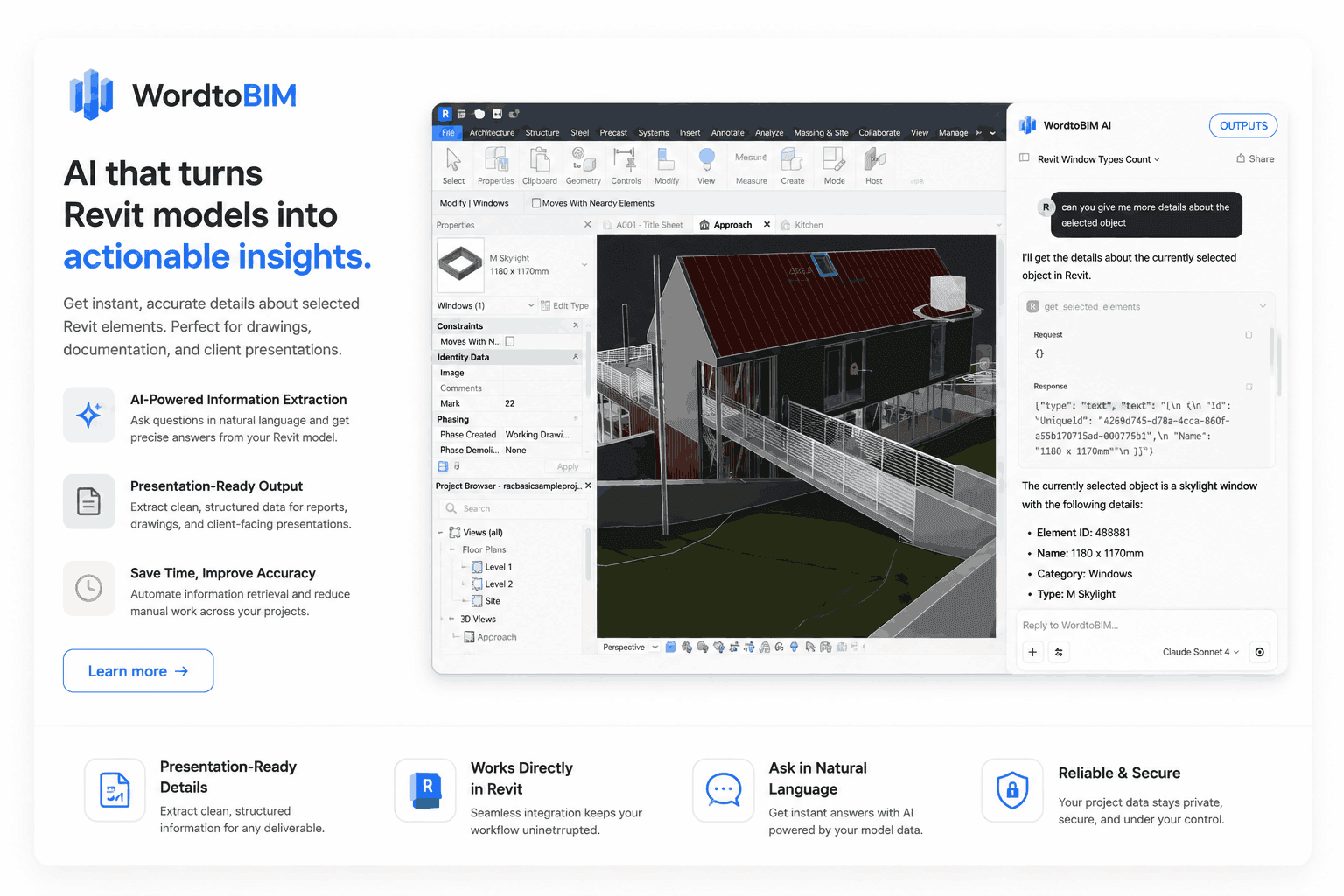
Natural-language BIM introduces a transformative way to interact with design software: describing spatial arrangements in plain text rather than executing dozens of manual software commands.
An instruction such as "create a three-meter partition on Level 2 with a centered door" mirrors how architectural teams natively communicate. However, converting spoken or written instructions into precise 3D model geometry requires deep technical integration.
Deploying natural language BIM AI modeling connects conversational prompts directly to underlying project databases and parametric rules.
- Resolving Ambiguity into Parametric Constraints Translating conversational text into accurate BIM elements requires resolving hidden project variables:
Spatial Referencing: Mapping relative terms like "Level 2" or "centered" to exact floor elevations, grid intersections, and spatial constraints.
Property Assignment: Assigning standard BIM attributes—such as fire ratings, acoustic performance, structural families, and material parameters.
Standardization Alignment: Enforcing project-specific naming conventions and classification codes (e.g., Uniclass, OmniClass).
When a natural language prompt is ambiguous, dependable text to BIM generative AI systems request clarification or display proposed visual previews rather than generating inaccurate geometry.
- Standardizing Prompt Libraries for Repetitive Layouts Practices can build reusable natural-language command templates for recurring modeling tasks:
Standard Enclosures: Quickly generating compliant restroom layouts, stair cores, or office partitions.
Routine Scheduling: Running complex schedule queries using text inputs like "list all unrated timber doors on Floor 3."
Batch Adjustments: Modifying system parameters across multiple elements simultaneously.
These reusable prompts establish a practice-wide digital modeling standard that speeds up routine setup tasks.
- Maintaining Version Control and Professional Oversight Language-based modeling is designed to augment technical expertise, not bypass professional oversight or safety regulations.
Every prompt-generated action must remain transparent and reversible—providing visual previews, object change logs, and simple undo functionality. Architects and BIM managers retain full accountability for design quality, code compliance, and structural integrity. Flowing natural-language prompts through established project standards lets designers test spatial concepts faster while staying inside a controlled 5D BIM environment.