Why do large-scale construction projects struggle to resolve complex legal disputes?

Concolabs Editorial
Concolabs Editor

Large-scale construction projects, such as multi-billion dollar infrastructure expansions, frequently stall when disputes arise over contractual obligations and physical site reality. When teams cannot reconcile 3D models with legal documents and project records, they face months of litigation. BuilderBot.ai offers a solution by providing a FIDIC-trained AI that reads contracts, models, and records together to provide clause-referenced answers.
Key Takeaways
- Fragmented data between legal contracts and physical site models is a primary driver of project litigation.
- Manual review of thousands of pages of documentation creates significant bottlenecks in claims resolution.
- BuilderBot.ai allows teams to query contracts, 3D models, and site records simultaneously for faster, evidence-based insights.
- Professional human judgment remains essential for final legal interpretation and strategy.
Why does data fragmentation fuel construction litigation?
Disputes often arise because the legal team and the engineering team operate in silos. Contracts define obligations in text, while 3D models define the physical scope. When these two sources of truth diverge, identifying the root cause of a claim becomes a manual, error-prone process. Without a unified view, stakeholders often rely on incomplete information, leading to protracted legal battles that drain project budgets.
How does FIDIC-trained AI improve claim accuracy?
BuilderBot.ai is specifically designed to bridge the gap between complex legal language and technical project data. By training on FIDIC standards, the AI understands the nuances of construction contracts and can map specific clauses to real-world site conditions. This capability allows legal and consulting teams to quickly verify if a change order or delay is supported by the contract, reducing the time spent on document discovery.
What is the workflow for cross-referencing models and contracts?
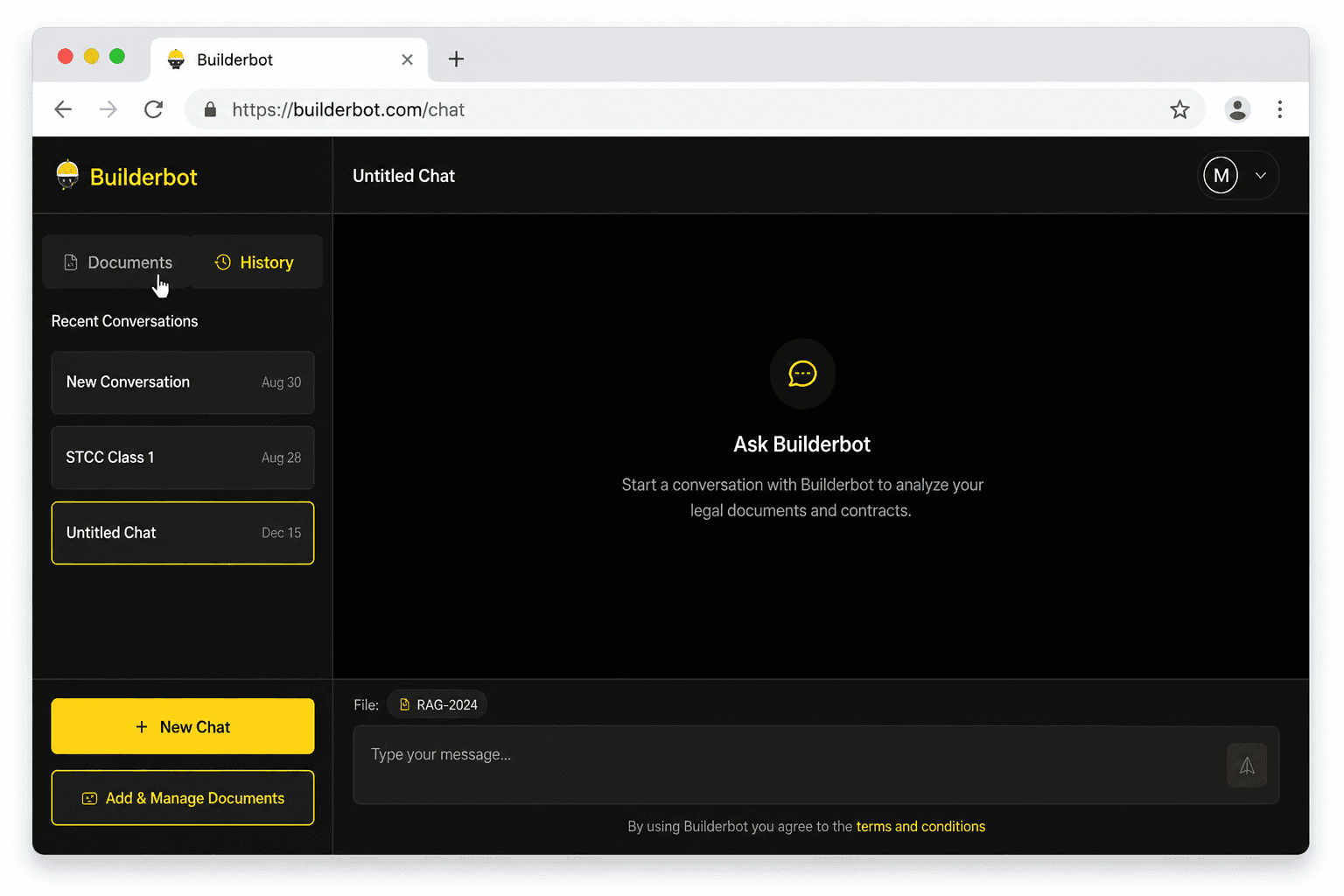
The [INTERNAL-LINK: construction workflow -> /learnmore/builderbot] involves uploading your 3D models alongside relevant contract documents and project records. Once indexed, you can ask questions that span these disparate data types. For example, you might ask the system to identify the contractual responsibility for a specific structural deviation found in the 3D model. The AI returns a clause-referenced answer, providing a clear audit trail for your claim.
Can AI replace the need for legal counsel?
No, AI is a tool for efficiency, not a replacement for professional legal judgment. While BuilderBot.ai excels at surfacing relevant information and linking contractual obligations to physical data, the final interpretation of law and strategy must be handled by qualified professionals. The AI serves to accelerate the preparation phase, allowing legal teams to focus on high-level strategy rather than manual document review.
Where should firms start with automated dispute analysis?
Firms should begin by identifying high-risk areas where contract-model discrepancies are common, such as MEP coordination or structural changes. By applying BuilderBot.ai to these specific segments, teams can demonstrate the value of data-driven insights. This targeted approach helps build confidence in the technology while providing immediate relief to teams overwhelmed by complex [INTERNAL-LINK: legal disputes -> /learnmore/builderbot] and documentation requests.
Dispute Resolution Preparation Checklist
- Consolidate all contract versions and addenda into a single digital repository.
- Ensure 3D models are updated to the latest 'as-built' or 'as-designed' status.
- Gather daily site reports and correspondence that relate to the specific dispute area.
- Upload documents to BuilderBot.ai for initial indexing and clause mapping.
- Formulate specific, clause-based questions to query the integrated dataset.
- Review AI-generated references against original source documents for accuracy.
- Draft the formal claim or defense strategy based on the AI-verified evidence.
Evidence required before publishing: Evidence required before publishing: A screenshot of the BuilderBot.ai interface showing a query result that links a specific FIDIC clause to a 3D model element, verified by a senior consultant.
Frequently Asked Questions
How does BuilderBot.ai handle multiple versions of a contract?
BuilderBot.ai allows users to upload multiple versions of contract documents. The system indexes these files, enabling the AI to distinguish between original agreements and subsequent addenda or variations. This ensures that when you query a clause, the AI references the most current and applicable version, preventing reliance on outdated contractual terms.
Can the AI analyze 3D models directly?
Yes, BuilderBot.ai is designed to ingest and process 3D models alongside text-based contract documents. By integrating these formats, the AI can cross-reference physical dimensions and spatial data from the model with the legal requirements defined in the contract, allowing for a comprehensive analysis of potential claims or compliance issues.
Is the data uploaded to Concolabs secure?
Security is a priority for Concolabs. We implement robust encryption and access controls to ensure that sensitive project data, including legal contracts and proprietary 3D models, remains confidential. Our infrastructure is designed to meet the high security standards required by global construction firms and legal consultancies operating in the UAE and beyond.
What happens if the AI provides an incorrect reference?
BuilderBot.ai is designed to provide clause-referenced answers, meaning every output is linked directly to the source document. Users can click these references to verify the context immediately. If an error occurs, the transparency of the citation allows for quick human correction, ensuring that the final legal output remains accurate and reliable.
Does this tool work for non-FIDIC contracts?
While BuilderBot.ai is trained on FIDIC standards, it is highly adaptable to other contract types. The AI's ability to ingest and analyze text allows it to identify key obligations and clauses in various legal frameworks. Users can upload their specific project contracts to tailor the AI's analysis to their unique legal requirements.
What should the reader do next?
Resolving complex construction disputes requires moving beyond manual document review toward a more integrated, data-driven approach. By leveraging tools like BuilderBot.ai, legal and consulting teams can bridge the gap between their contracts and 3D models, ensuring that decisions are backed by clear, clause-referenced evidence. Explore how this technology can support your firm at /learnmore/builderbot.
Review the workflow with the Concolabs team, confirm the required inputs and professional review points, then explore BuilderBot.ai.