Why do contractual disputes often stall construction project progress?

Concolabs Editorial
Concolabs Editor

Construction projects frequently stall when contractual obligations clash with physical site realities. When teams cannot quickly reconcile legal clauses with 3D models and daily progress records, disputes escalate into costly litigation. By adopting a unified data approach, firms can bridge the gap between legal intent and site execution.
Key Takeaways
- Fragmented data between contracts and site records is the primary driver of construction disputes.
- AI tools can now cross-reference legal clauses with 3D models and project logs.
- Early identification of discrepancies prevents minor issues from becoming legal bottlenecks.
- Professional human oversight remains essential for final legal interpretations.
Why does data fragmentation lead to legal disputes?
Disputes often stem from a lack of a single source of truth. When contract documents exist in isolation from 3D models and site progress reports, teams struggle to verify compliance. This disconnect creates ambiguity during claims, as parties argue over conflicting interpretations of site conditions versus contractual requirements. Centralizing these data streams is the first step toward resolution.
How can AI help reconcile complex construction contracts?
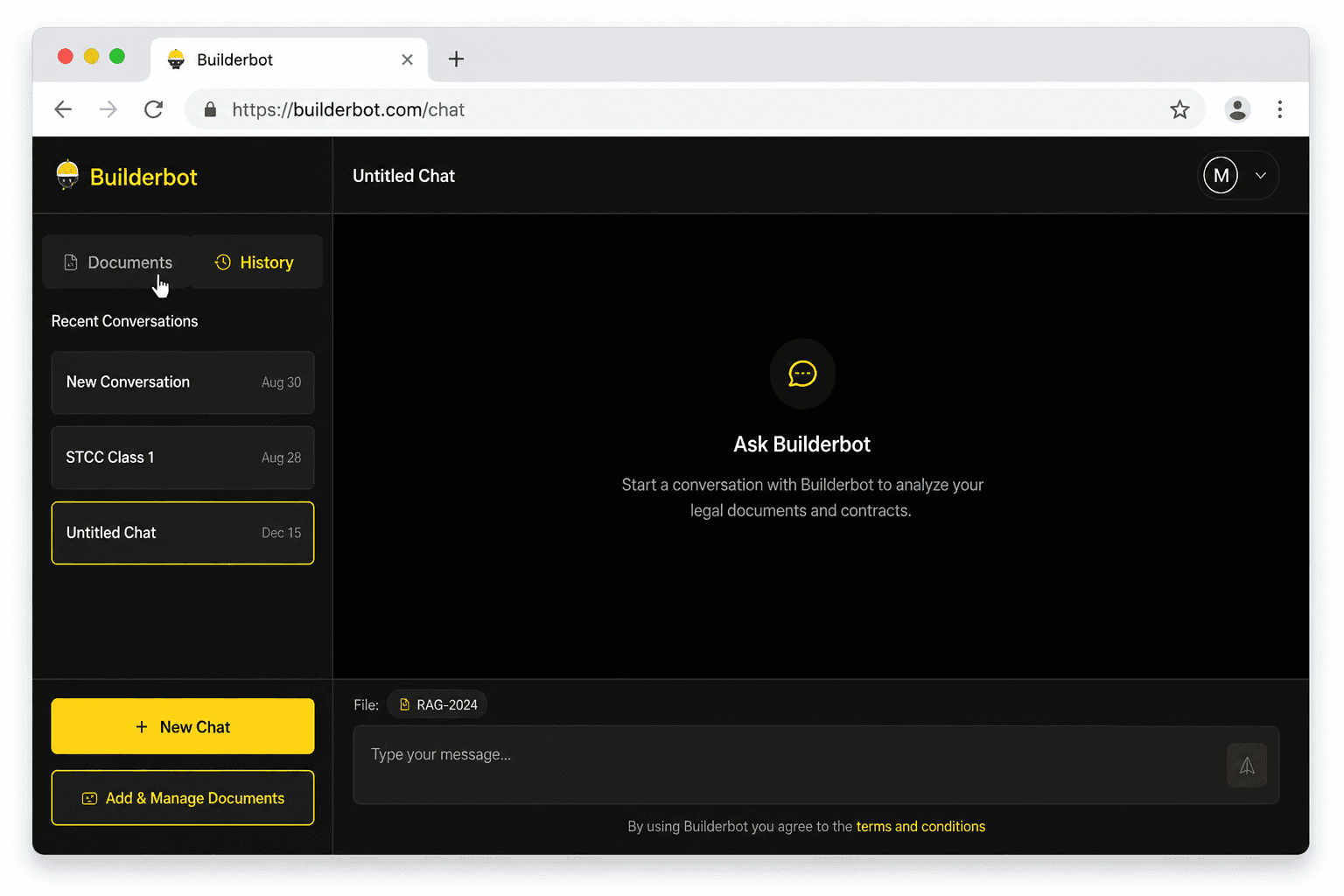
BuilderBot.ai provides a FIDIC-trained legal AI that reads contracts, models, and records together. By allowing users to upload 3D models alongside legal documentation, the platform enables teams to ask questions that span multiple data sources simultaneously. This capability allows for clause-referenced answers that clarify obligations based on the actual state of the project.
What is the role of FIDIC-trained AI in claims management?
FIDIC contracts are notoriously complex, requiring precise interpretation of risk allocation. BuilderBot.ai assists by mapping specific contract clauses to the relevant physical project data. This reduces the time spent manually searching through thousands of pages of documentation, allowing legal and consulting teams to focus on strategy rather than data retrieval.
How do you implement a unified data workflow?
A successful workflow requires integrating your [INTERNAL-LINK: project documentation -> connected-construction-data-workflow-project-lifecycle] with AI-ready systems. Start by digitizing all site records and ensuring 3D models are updated to reflect current progress. Once the data is unified, you can use Concolabs tools to query the relationship between your legal obligations and the physical site status.
What are the limitations of AI in legal disputes?
While AI accelerates the identification of evidence, it does not replace professional legal judgment. AI tools like BuilderBot.ai are designed to support experts by surfacing relevant information, but the final interpretation of liability and contractual intent must be performed by qualified legal professionals. Always treat AI outputs as a starting point for your [INTERNAL-LINK: legal review -> ai-construction-claims-contract-evidence].
Contractual Dispute Prevention Checklist
- Ensure all contract documents are digitized and searchable.
- Verify that 3D models are updated to match current site progress.
- Centralize daily site reports within a single platform.
- Use BuilderBot.ai to cross-reference specific clauses against site records.
- Identify potential discrepancies before they escalate into formal claims.
- Maintain a clear audit trail of all AI-assisted queries and findings.
Evidence required before publishing: Evidence required before publishing: A screenshot showing BuilderBot.ai displaying a clause-referenced answer alongside a 3D model, verified by a senior consultant.
Frequently Asked Questions
How does BuilderBot.ai handle different contract types?
BuilderBot.ai is specifically trained on FIDIC standards, allowing it to understand the nuances of international construction contracts. It processes uploaded documents to provide context-aware answers that align with standard industry legal frameworks.
Can I upload my own 3D models to the platform?
Yes, the platform supports the integration of 3D models alongside your contract documents. This allows you to query the relationship between your design specifications and the legal requirements outlined in your project agreements.
Does the AI provide legal advice?
No, the AI does not provide legal advice. It serves as a tool to help legal and consulting teams find evidence and cross-reference data more efficiently. All final legal decisions must be made by qualified professionals.
How does this improve the speed of dispute resolution?
By automating the manual search of thousands of pages of documents and models, the platform reduces the time required to gather evidence. This allows teams to resolve potential disputes early, often before they require formal litigation.
Is the data secure when using Concolabs?
Concolabs prioritizes data security for all construction and legal firms. We ensure that your project documentation and models are handled with strict confidentiality protocols, suitable for sensitive legal and consulting environments.
What should the reader do next?
Resolving construction disputes requires moving away from manual, fragmented data review. By leveraging tools like BuilderBot.ai, your team can unify contracts, models, and records to make informed decisions faster. To see how this workflow can support your next project, visit /learnmore/builderbot.
Review the workflow with the Concolabs team, confirm the required inputs and professional review points, then explore BuilderBot.ai.