How Should Construction Contract AI Be Used Safely?
Concolabs Editorial
Concolabs Editor

How Should Construction Contract AI Be Used Safely?
Construction contract AI should be used as a research and evidence assistant, not an autonomous legal decision-maker. Safe use requires the correct contract and amendments, clause-referenced answers, links to source records, visible uncertainty, access controls and review by authorized contract or legal professionals before notices, claims, certifications or strategic decisions are issued.
Key takeaways
- The governing contract, amendments and project particulars must be complete.
- Every material answer should point to the relevant clause and record.
- AI should distinguish contract text, project fact and inference.
- Deadline, entitlement and valuation conclusions require professional review.
- Permissions and confidentiality controls should match the sensitivity of the records.
What can construction contract AI do well?
It can search large document sets, locate clauses, summarize defined procedures, build event timelines, compare records and identify missing information for review. It can help a project professional move from a question to relevant evidence more quickly.
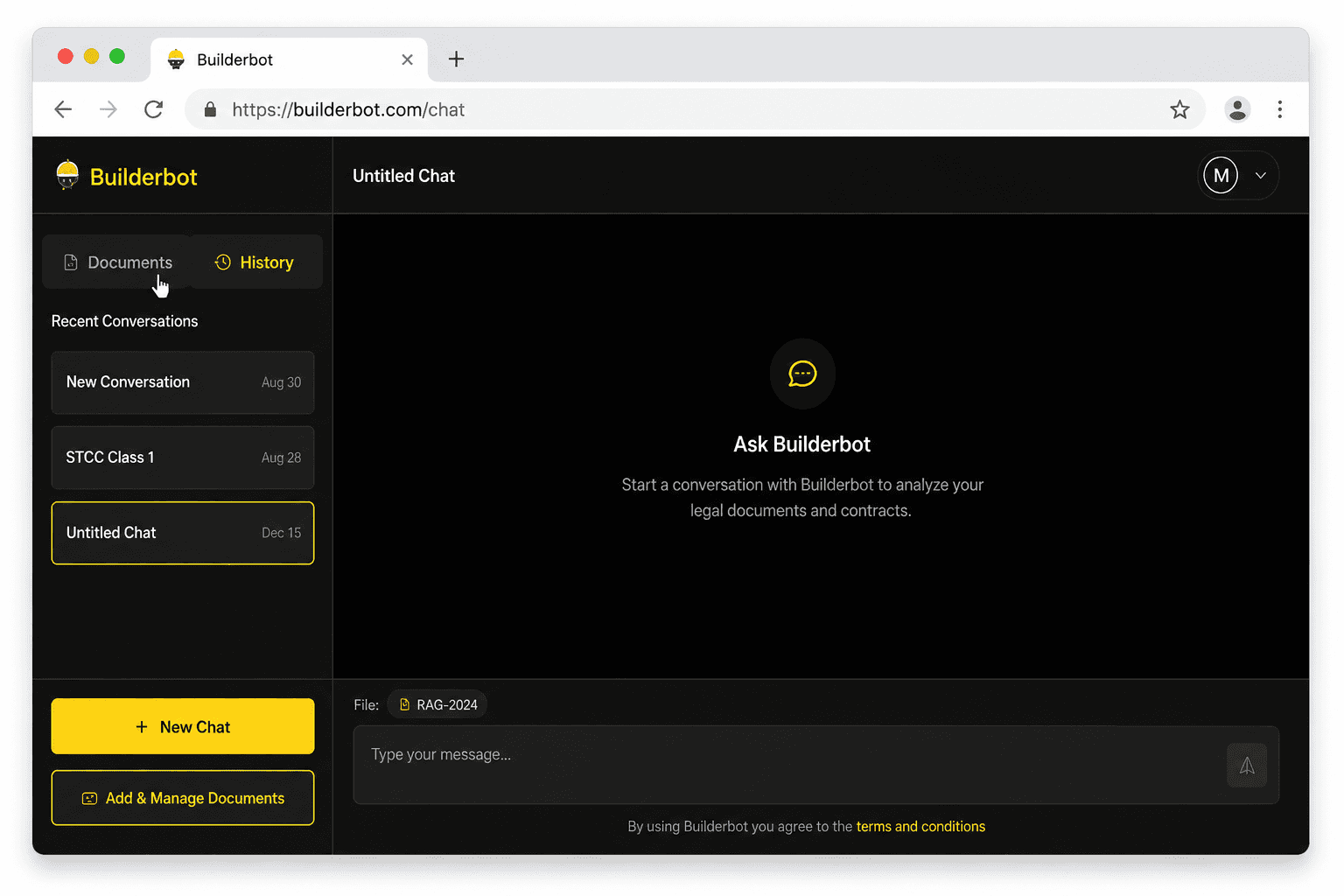
BuilderBot.ai is described as a FIDIC-trained AI that reads contract documents, 3D models and project records together and returns clause-referenced answers. This connected context can be useful when a question depends on both contractual wording and project facts.
What should construction contract AI not decide alone?
It should not independently determine legal entitlement, waive rights, issue notices, certify money or time, approve settlement, or make strategic claim decisions. Those actions depend on authority, jurisdiction, complete facts and professional judgment.
The AI may prepare a draft analysis, but the responsible person must test the assumptions and approve any external communication.
What documents should be included?
Include the signed contract, conditions, contract data, schedules, amendments, specifications and relevant incorporated documents. For project-specific questions, include controlled correspondence, instructions, programmes, progress records, drawings or models, measurements and prior decisions.
Label status and revision. A superseded programme or unsigned amendment can materially change an answer if the system treats it as current.
What should a trustworthy answer contain?
A trustworthy answer should state the conclusion in plain language, cite the relevant clause or document, identify project records relied upon, distinguish facts from assumptions and flag missing or conflicting evidence. It should also state when the question requires professional or jurisdiction-specific advice.
An answer that sounds certain but gives no source path is difficult to verify and should not be used for a consequential decision.
How should teams verify contract AI outputs?
Use a review checklist:
- Is the correct contract version loaded?
- Does the cited wording support the answer?
- Are amendments and project particulars considered?
- Are the referenced project facts complete and current?
- Does the answer confuse fact, interpretation and recommendation?
- Are notice requirements and deadlines verified independently?
- Has the authorized professional approved the next action?
For recurring questions, record reviewer corrections and improve document organization or prompts rather than relying on informal memory.
How should confidentiality and access be managed?
Use role-based permissions and limit access to projects and documents necessary for each user. Confirm processing, retention and training terms before uploading legally sensitive records. Preserve logs of document uploads, questions, outputs and approved use where required by company policy.
Do not place privileged or restricted material in a system until the organization has confirmed the appropriate controls and legal basis.
Can contract AI help with claims?
It can help organize clauses, events, notices, model context and site records, and can highlight evidence gaps. It can also assist with chronology and draft issue framing. However, claim strategy, entitlement, causation, quantum and legal advice remain professional responsibilities.
The best use is evidence acceleration: help qualified people find and assess the right material sooner.
Frequently Asked Questions
Is construction contract AI legal advice?
No. It can support research and analysis, but its output should not be treated as legal advice or a substitute for authorized contract and legal professionals. Requirements vary by contract and jurisdiction.
Why are clause references important in contract AI?
Clause references let reviewers verify whether the cited wording actually supports the answer and whether amendments change it. They turn a confident statement into a checkable starting point for professional analysis.
Can contract AI calculate claim entitlement automatically?
It may organize relevant provisions and evidence, but entitlement depends on complete facts, compliance, causation and interpretation. A qualified professional should determine the position and approve any notice or submission.
What happens if the contract documents conflict?
The system should flag the conflict and identify the relevant documents rather than silently choosing one. An authorized reviewer must apply the contract’s precedence rules and consider amendments and project particulars.
Should AI-generated contract answers be stored?
Store consequential analyses according to project and company policy, together with their source set, date, reviewer and status. Clearly label drafts so they are not mistaken for approved contractual positions.
Learn more about clause-referenced, multi-document construction intelligence on the BuilderBot.ai page.