How can construction firms resolve complex remediation claims without years of litigation?
Concolabs Editorial
Concolabs Editor

Large-scale remediation claims, such as those involving multi-million pound structural defects, often paralyze project stakeholders for years. The core difficulty lies in reconciling disparate data sources: legal contracts, complex 3D models, and daily site records. When these documents remain siloed, establishing liability becomes a manual, error-prone process. Concolabs offers a solution through BuilderBot.ai, a platform designed to unify these sources into a single, queryable environment.
Key Takeaways
- Fragmented data is the primary driver of delays in construction remediation claims.
- BuilderBot.ai allows users to query contracts, 3D models, and site records simultaneously.
- AI-assisted analysis reduces the time required to cross-reference liability clauses with physical site evidence.
- Human professional judgment remains essential for final legal interpretation and strategy.
Why do remediation claims become so complex?
Remediation claims typically involve high-stakes disputes over structural integrity or compliance failures. The complexity arises because the evidence is rarely in one place. A contract might define specific performance standards, while the 3D model shows the intended design, and site records document what was actually installed. Reconciling these requires deep document review that often takes months of manual effort, leading to significant commercial risk and stalled project resolution.
How does BuilderBot.ai integrate project documentation?
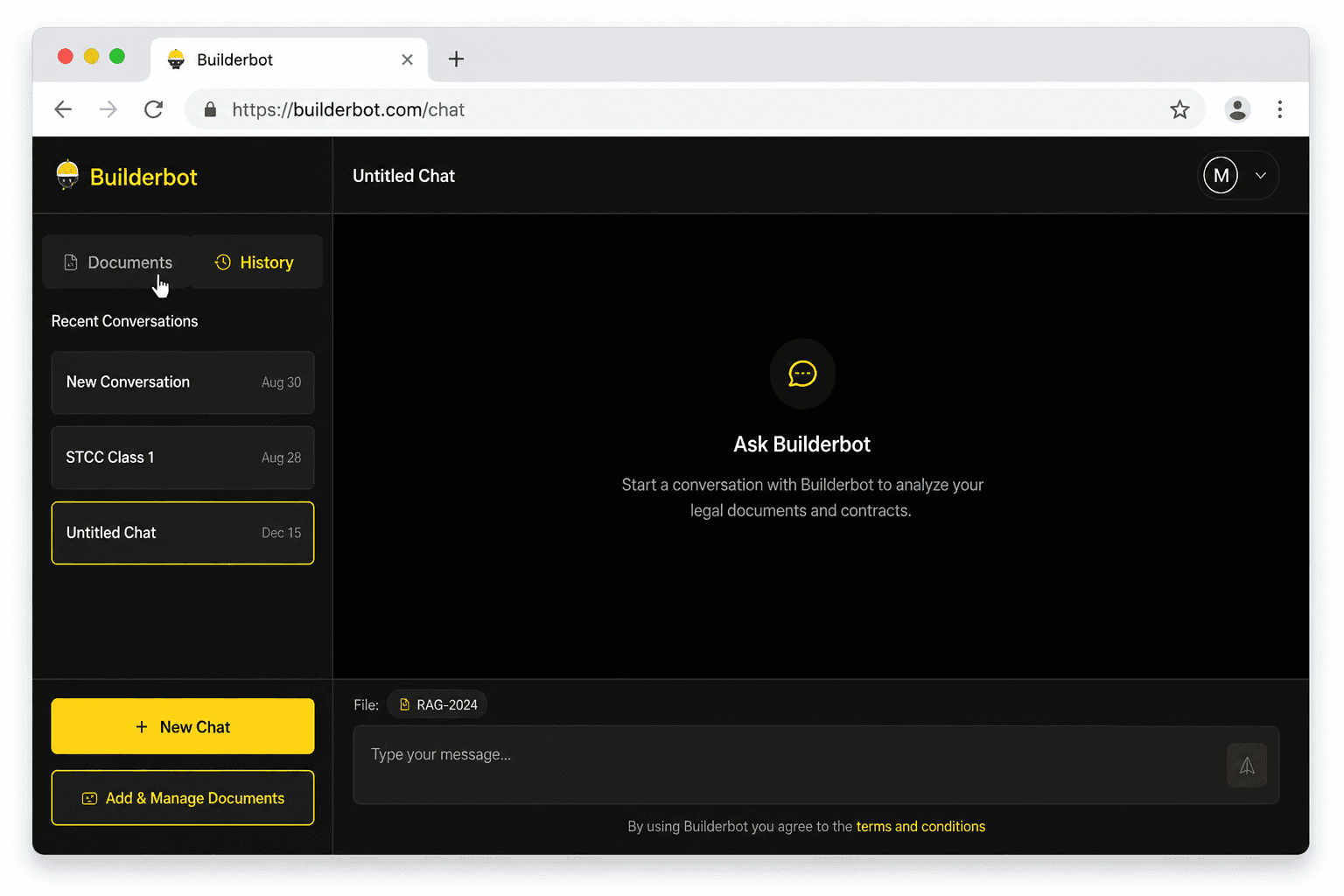
BuilderBot.ai functions as a FIDIC-trained legal AI that reads contracts, models, and records together. By uploading these documents into a unified workspace, the platform creates a relational database of project information. This allows consultants and legal teams to ask specific questions about compliance or liability that span multiple document types, effectively bridging the gap between legal text and physical construction data.
Can AI provide clause-referenced answers for disputes?
Yes, the platform provides clause-referenced answers, ensuring that every insight is tied directly to the source material. When a user asks whether a specific remediation task falls under a contractor's responsibility, BuilderBot.ai identifies the relevant sections in the contract and cross-references them with the corresponding 3D model data or site logs. This [INTERNAL-LINK: accelerates legal review -> ai-construction-claims-contract-evidence] by providing a clear audit trail.
What is the role of professional judgment in AI-assisted claims?
While BuilderBot.ai excels at data retrieval and cross-referencing, it does not replace the need for professional legal or engineering judgment. The AI identifies potential evidence and highlights contradictions, but the final assessment of liability and the development of a legal strategy must be performed by qualified professionals. The tool is designed to support, not substitute, the expertise of [INTERNAL-LINK: construction consultants -> connected-construction-data-workflow-project-lifecycle].
Where should firms start when building a case?
The first step in any remediation claim is centralizing the data. Firms must ensure that all relevant contracts, as-built models, and site records are digitized and accessible. Once the data is centralized, using tools like BuilderBot.ai allows teams to perform a rapid gap analysis. This initial [INTERNAL-LINK: document triage -> ai-tender-evaluation-construction-bids] determines the strength of the claim before committing to formal litigation proceedings.
Remediation Evidence Preparation Workflow
- Compile all relevant FIDIC-based contract documents and amendments.
- Verify that the 3D model reflects the as-built state of the site.
- Aggregate daily site logs and progress reports for the period in question.
- Upload all documentation into the BuilderBot.ai secure environment.
- Formulate specific queries focused on liability and performance clauses.
- Review AI-generated findings against physical project evidence.
- Consult with legal counsel to finalize the claim strategy.
Evidence required before publishing: Evidence required before publishing: A screenshot of the BuilderBot.ai interface showing a query result that links a specific contract clause to a 3D model element, verified by a senior product manager.
Frequently Asked Questions
How does BuilderBot.ai handle FIDIC contract standards?
BuilderBot.ai is specifically trained on FIDIC contract structures. It recognizes the standard terminology, clause hierarchies, and risk allocation frameworks inherent in these documents, allowing it to provide more accurate, context-aware answers when analyzing complex construction disputes and remediation claims.
Can the AI analyze 3D models directly?
Yes, the platform allows you to upload 3D models alongside your contract documents. It maps the data within the model to the requirements outlined in the text, enabling you to ask questions that span both the physical design and the legal obligations of the project.
Is the data uploaded to Concolabs secure?
Concolabs prioritizes data security for all construction and legal clients. We employ enterprise-grade encryption and access controls to ensure that your sensitive project documents, models, and records remain confidential and protected throughout the entire analysis process.
Does this tool replace the need for a construction lawyer?
No. BuilderBot.ai is a productivity tool designed to assist legal and consulting professionals by automating the retrieval and cross-referencing of evidence. It provides the data necessary for informed decision-making, but it does not provide legal advice or replace the professional judgment of qualified legal counsel.
What happens if the AI finds conflicting information?
When the AI identifies contradictions between documents, it flags them for human review. It presents the conflicting sources side-by-side, allowing the user to examine the discrepancy and determine how to proceed based on the specific project context and legal requirements.
What should the reader do next?
Resolving remediation claims requires a shift from manual, document-heavy workflows to data-driven analysis. By using BuilderBot.ai to unify your contracts, models, and records, you can significantly reduce the time spent searching for evidence and focus on resolving the dispute. To see how this workflow can be applied to your current project, visit /learnmore/builderbot.
Review the workflow with the Concolabs team, confirm the required inputs and professional review points, then explore BuilderBot.ai.