How can construction firms manage complex fire safety disputes without manual document review?
Concolabs Editorial
Concolabs Editor

High-value construction disputes, such as those involving multi-million pound fire safety compliance, often hinge on the ability to connect disparate project data. When documentation is siloed across contracts, 3D models, and site records, legal teams struggle to verify compliance. Concolabs addresses this by providing a unified AI-driven approach to cross-referencing these complex datasets.
Current industry problem signal: Willmott Dixon firms drawn into £113m fire safety dispute from Construction News. This source identifies the topic; factual claims still require editorial verification.
Key Takeaways
- Fragmented project data is the primary barrier to resolving high-value construction disputes quickly.
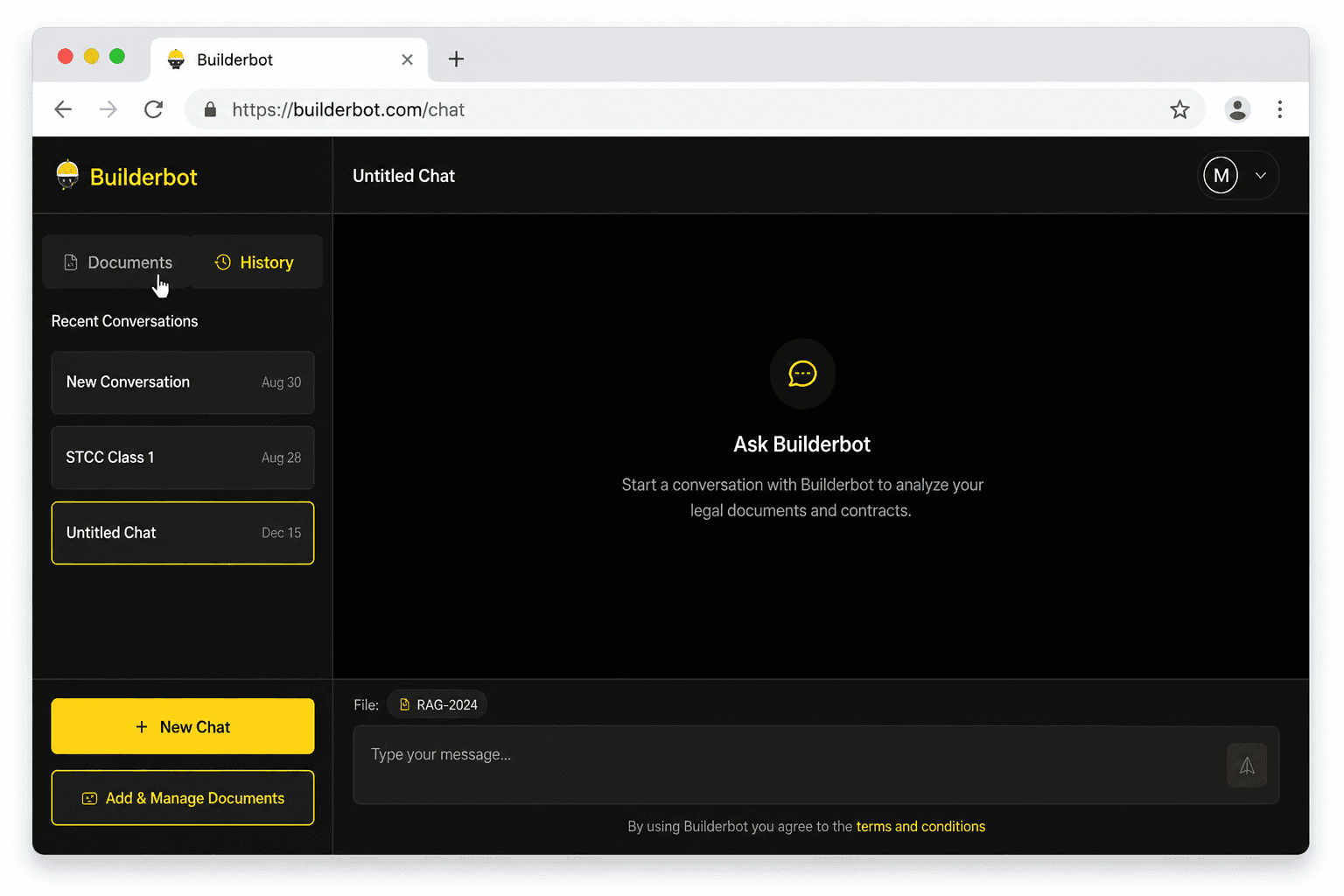
- BuilderBot.ai allows users to query contracts, 3D models, and site records in a single interface.
- AI tools provide clause-referenced answers that accelerate legal review while maintaining human oversight.
- Data integration reduces the risk of overlooking critical evidence in complex fire safety litigation.
Why do fire safety disputes become so complex?
Fire safety disputes are complex because they require reconciling technical design specifications with legal contract obligations and actual site conditions. When a dispute arises, legal teams must manually cross-reference thousands of pages of documentation. This process is time-consuming and prone to human error, often leading to prolonged litigation cycles that drain project resources.
How does BuilderBot.ai bridge the gap between legal and technical data?
BuilderBot.ai functions as a FIDIC-trained legal AI that reads contracts, models, and records together. By allowing users to upload 3D models alongside contract documents, the platform enables queries that span multiple data types. This capability ensures that when a question is asked about a specific fire safety clause, the AI can reference the relevant section of the contract and the corresponding geometry in the model.
What is the role of AI in evidence gathering?
AI acts as a force multiplier in evidence gathering by rapidly scanning large volumes of unstructured data. Rather than manual keyword searches, BuilderBot.ai provides clause-referenced answers that point directly to the source material. This allows legal professionals to focus on interpreting the evidence rather than spending weeks locating it within fragmented project archives.
Can AI replace professional legal judgment?
No, AI cannot replace professional legal judgment. While BuilderBot.ai excels at identifying and linking relevant data points, the final interpretation of liability and compliance remains the responsibility of qualified legal experts. The tool is designed to support the workflow of [INTERNAL-LINK: construction legal teams -> legal-consulting-services], providing a foundation of verified data upon which informed decisions can be made.
How to implement a data-driven dispute resolution workflow?
Implementing a data-driven workflow requires centralizing project documentation before a dispute escalates. By using tools like BuilderBot.ai to maintain a clear link between [INTERNAL-LINK: project records -> digital-daily-progress-reports-site-teams] and contractual requirements, firms can proactively identify compliance gaps. This approach transforms reactive litigation into a structured, evidence-based process.
Dispute Readiness Checklist
- Centralize all contract versions and addendums in a searchable format.
- Ensure 3D models are updated with as-built data for accurate reference.
- Compile comprehensive site records, including daily reports and inspection logs.
- Use BuilderBot.ai to cross-reference contract clauses with technical model data.
- Verify AI-generated findings against original source documents for accuracy.
- Consult with legal counsel to validate the evidence chain for potential litigation.
Evidence required before publishing: Evidence required before publishing: Please provide a screenshot of the BuilderBot.ai interface showing a query result that references both a contract clause and an element within a 3D model. Include a brief statement from a legal consultant verifying the utility of this cross-referencing feature in a mock dispute scenario.
Frequently Asked Questions
How does BuilderBot.ai handle different types of construction documents?
BuilderBot.ai is designed to ingest and process a variety of formats, including legal contracts, technical specifications, and 3D model files. By using advanced parsing, it aligns these disparate data types, allowing users to ask questions that require information from multiple sources simultaneously.
Is the AI output legally binding?
No, the output generated by BuilderBot.ai is not legally binding. The tool is intended to assist legal and construction professionals by surfacing relevant evidence and linking documents. All findings must be reviewed and verified by qualified professionals before being used in legal proceedings or dispute resolution.
Can this tool be used for projects outside the UAE?
Yes, BuilderBot.ai is built to handle global construction standards, including FIDIC contracts, which are widely used internationally. Its ability to process complex documentation makes it a versatile tool for firms operating in various jurisdictions where contract compliance and technical accuracy are paramount.
How does the AI ensure accuracy in clause referencing?
The AI uses a retrieval-augmented generation process to ensure that its answers are directly linked to the provided source documents. By citing the specific clause or model element, it allows users to verify the information instantly, reducing the risk of hallucinations or misinterpretation of complex legal text.
What is the first step to integrating Concolabs into a dispute workflow?
The first step is to consolidate your project documentation—contracts, models, and site records—into a secure, accessible format. Once your data is centralized, you can begin using BuilderBot.ai to index these files and start querying your project history to identify compliance gaps or evidence for ongoing claims.
What should the reader do next?
Resolving complex construction disputes requires more than just legal expertise; it requires the ability to synthesize technical and contractual data into a clear narrative. By leveraging tools like BuilderBot.ai, firms can move beyond manual document review and build a more robust, evidence-backed strategy. Learn more about how to optimize your dispute resolution process at /learnmore/builderbot.
Review the workflow with the Concolabs team, confirm the required inputs and professional review points, then explore BuilderBot.ai.