Can a verbal instruction really become a valid construction claim?

Concolabs Editorial
Concolabs Editor

Verbal instructions on a construction site are a common source of friction. When a site manager gives a direction that deviates from the original plan, it often lacks the formal documentation required to support a subsequent claim. This ambiguity creates significant commercial risk for contractors and consultants alike. By integrating [INTERNAL-LINK: legal AI tools -> /learnmore/builderbot] into your workflow, you can cross-reference these informal directions against project records and contract clauses to establish a clear audit trail.
Key Takeaways
- Verbal instructions frequently lack the contractual weight needed to justify additional costs or time extensions.
- Fragmented project data makes it difficult to link site-level changes to specific contract obligations.
- BuilderBot.ai allows teams to synthesize 3D models, contracts, and daily records to validate claims in real-time.
- Professional judgment remains essential when interpreting AI-generated insights for legal disputes.
Why do verbal instructions create legal uncertainty?
Verbal instructions often bypass the formal change management process defined in standard forms like FIDIC. Without a written record, proving that a direction was given—and that it constituted a variation—becomes a battle of memories. This uncertainty leads to delayed payments and protracted disputes. Using BuilderBot.ai, teams can ingest site logs and meeting minutes to identify where verbal directions were recorded, then immediately compare them against the relevant contract clauses to assess validity.
How can you link site records to contract obligations?
The primary challenge in construction claims is the disconnect between site reality and contract language. A verbal instruction might be noted in a daily report, but its impact on the 3D model or the project schedule is often overlooked. Concolabs provides a platform where you can upload these disparate data sources. By asking the system to cross-reference a specific site instruction with the contract, you gain a clause-referenced answer that clarifies your legal position.
What role does 3D modeling play in claim validation?
Visual evidence is often more persuasive than text alone. When a verbal instruction forces a change in design, the 3D model serves as the baseline for what was originally intended. BuilderBot.ai enables users to view these models alongside contract documents. This allows you to demonstrate exactly how a site-level change deviates from the approved design, providing a factual basis for your claim that is difficult to dispute.
How does AI improve the speed of claim preparation?
Manual claim preparation involves hours of searching through emails, site diaries, and contract PDFs. This [INTERNAL-LINK: manual review process -> /learnmore/builderbot] is prone to human error and oversight. AI-driven analysis accelerates this by surfacing relevant clauses and matching them to your specific project records. By reducing the time spent on document retrieval, your team can focus on the strategic aspects of the dispute, such as negotiation and settlement.
Are there limits to using AI for legal disputes?
While AI tools like BuilderBot.ai are powerful, they do not replace the need for professional legal or commercial judgment. AI can identify patterns and retrieve evidence, but it cannot determine the final legal strategy or the nuances of local construction law. Always treat AI outputs as a starting point for your analysis. Ensure that every claim submission is reviewed by a qualified professional to confirm its accuracy and compliance with [INTERNAL-LINK: project-specific requirements -> /learnmore/builderbot].
Verbal Instruction Validation Workflow
- Log the verbal instruction in the daily site report immediately.
- Identify the specific contract clause related to the instruction.
- Upload the relevant 3D model section to the AI platform.
- Use BuilderBot.ai to cross-reference the instruction against the contract.
- Document the potential impact on project schedule and cost.
- Submit a formal written confirmation of the instruction to the client.
- Review the AI-generated evidence with your legal or commercial team.
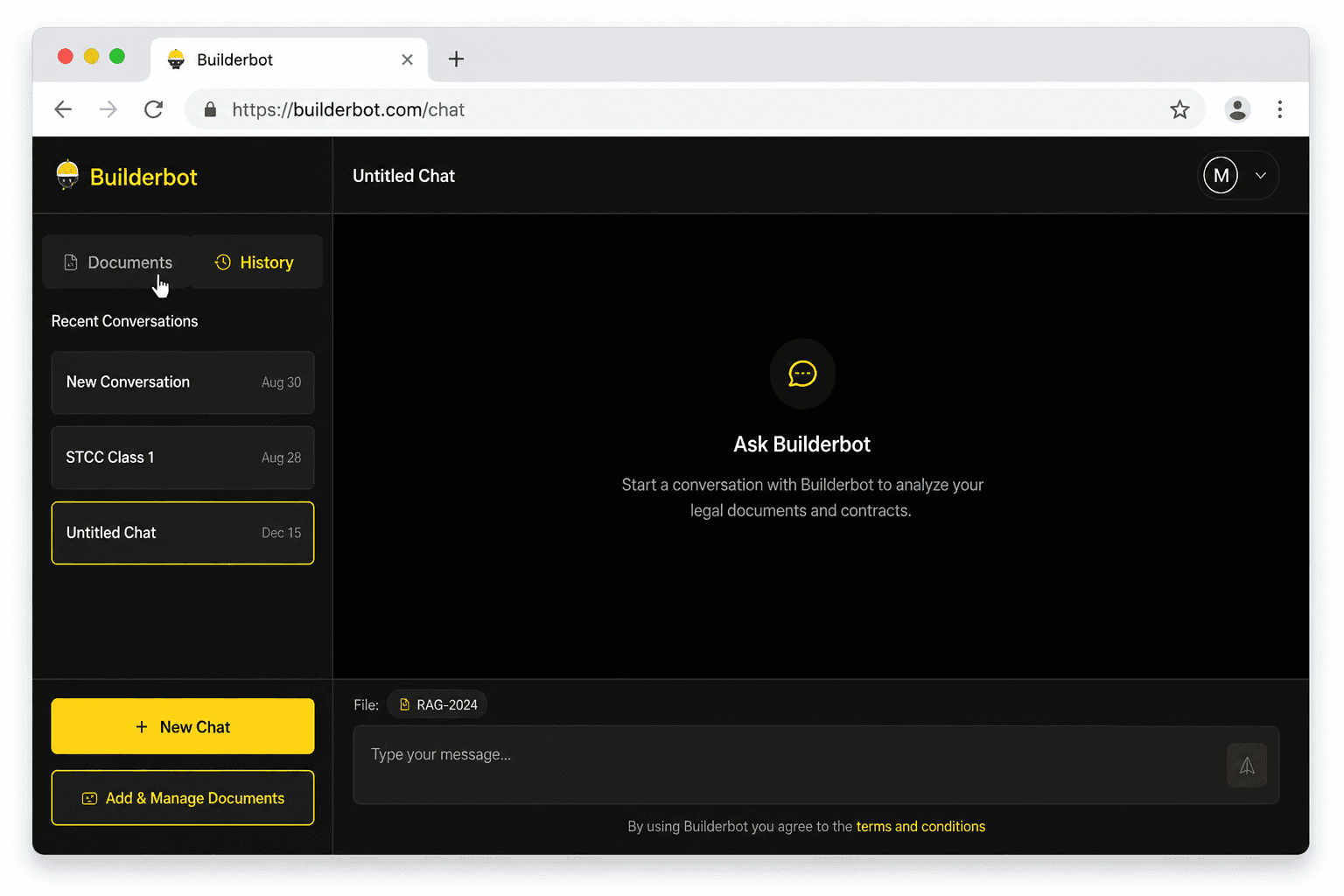
Evidence required before publishing: Evidence required before publishing: A screenshot of the BuilderBot.ai interface showing a query that links a site diary entry to a specific FIDIC contract clause, verified by a senior consultant.
Frequently Asked Questions
Can AI replace a human contract administrator?
No. AI is a tool designed to assist with data retrieval and cross-referencing. It cannot replace the professional judgment, negotiation skills, or deep understanding of local legal frameworks that a human contract administrator brings to a project.
How does BuilderBot.ai handle different contract types?
BuilderBot.ai is trained on FIDIC standards and can be adapted to various contract forms. By uploading your specific project documents, the AI learns the unique requirements and obligations of your contract, allowing it to provide clause-referenced answers tailored to your project.
Is my project data secure when using AI?
Security is a priority. Concolabs ensures that your project data, including 3D models and sensitive contract documents, is handled with strict confidentiality protocols. Data is used to support your specific project analysis and is not shared across other client environments.
What happens if the AI finds conflicting information?
When the system identifies conflicting data, it flags the inconsistency for human review. This allows you to investigate the discrepancy between the site record and the contract, ensuring that you are aware of potential risks before proceeding with a claim.
Can I use this for projects outside the UAE?
Yes. While our tools are highly effective for the complex legal environments in the UAE, the core functionality of linking site records, models, and contracts is applicable to construction projects globally, regardless of the specific jurisdiction.
What should the reader do next?
Verbal instructions are an inevitable part of construction, but they do not have to lead to unmanageable disputes. By adopting a systematic approach to documentation and leveraging AI to bridge the gap between site records and contract language, you can protect your project's financial health. To see how your team can start validating claims more effectively, learn more about BuilderBot.ai here.
Review the workflow with the Concolabs team, confirm the required inputs and professional review points, then explore BuilderBot.ai.