BuilderBot.ai: Clause-Referenced AI for Construction Contracts and Claims
Concolabs Editorial
Concolabs Editor

BuilderBot.ai: Clause-Referenced AI for Construction Contracts and Claims
Construction contract questions rarely belong to one document. The answer may depend on a contract clause, amendment, drawing, 3D model, instruction, notice, photograph, progress report, or email created months apart.
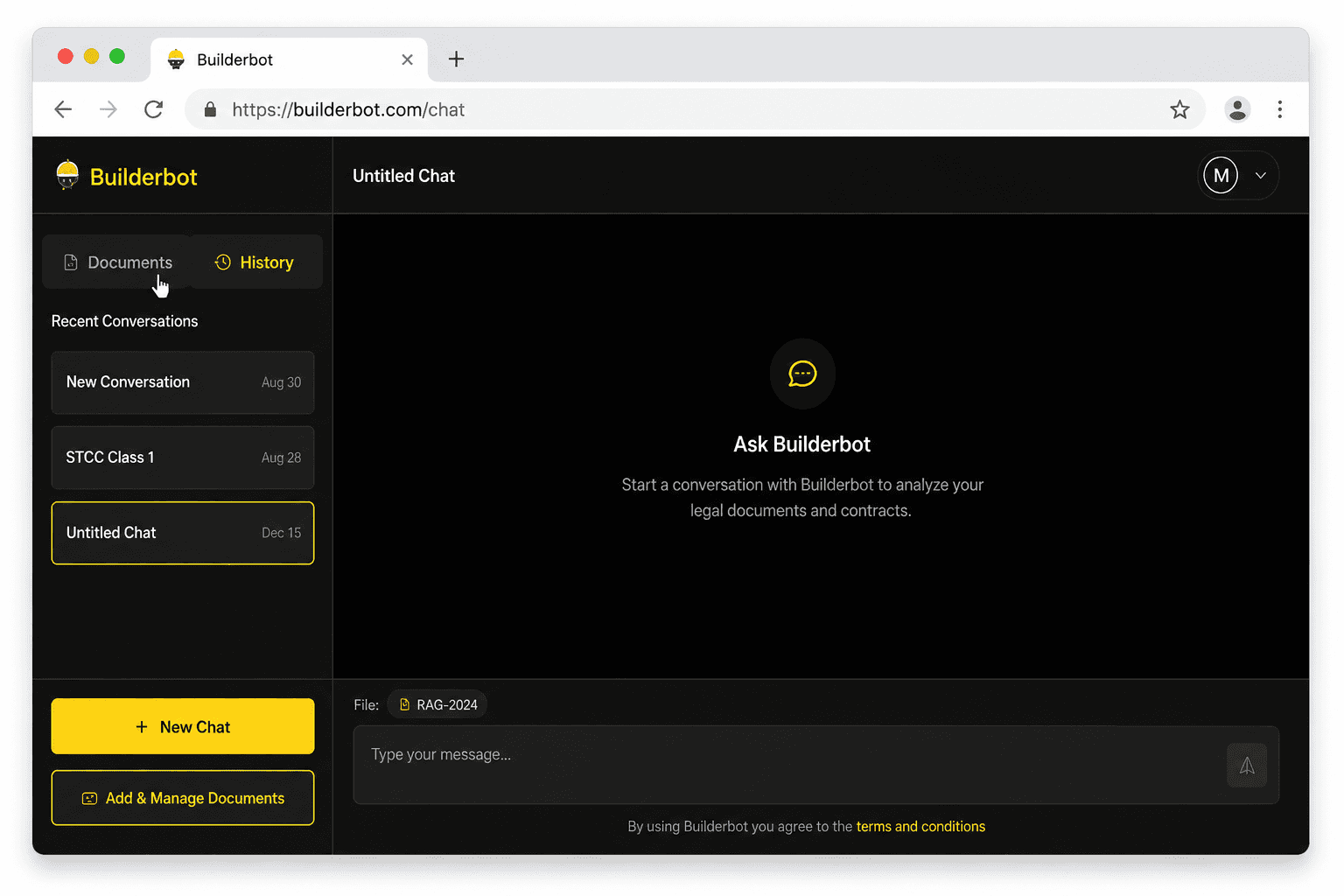
BuilderBot.ai brings those sources into one construction-focused workspace. Users upload contracts, drawings, models, correspondence, and project records, then ask questions in natural language. The system responds with clause numbers, related provisions, project evidence, and suggested next steps.
Fast retrieval doesn't replace legal interpretation. Every material answer should be checked against the cited source, the signed contract, its amendments, the governing law, and the project facts.
Key takeaways
- Analyze contracts, drawings, 3D models, correspondence, site records, and photos together.
- Ask plain-language questions through the web or connected communication workflows.
- Receive clause-referenced answers with related project evidence.
- Maintain a searchable audit history for later review.
- Concolabs currently lists individual access at USD $20 per month and enterprise access at USD $250 per month.
What is BuilderBot.ai?
BuilderBot.ai is a construction contract and dispute-research product trained for FIDIC-oriented workflows. It is designed for construction lawyers, legal consultants, claims professionals, contract managers, and other specialists who need to search across the complete project record.
Concolabs identifies the UAE as the primary market, with global availability. The product page states that teams can begin within one day by uploading information and asking questions.
BuilderBot.ai differs from a document-only search tool because it can cross-reference contract language with drawings and 3D models. This helps users investigate questions where the legal provision and physical project information must be understood together.
Why is construction contract research difficult?
Construction disputes develop across time and information systems. The signed contract may sit in one repository, amendments in another, drawings and models in the common data environment, notices in email, and site evidence in reports or photographs.
Keyword search can find the words inside a clause without showing how that clause interacts with amendments, related provisions, or the project record. Important facts may also appear in tables, schedules, drawings, or model geometry rather than narrative text.
Research therefore requires repeated cross-referencing. A specialist must identify the applicable clause, confirm the edition and amendments, locate supporting events, test notice compliance, and distinguish facts from assumptions.
BuilderBot.ai reduces search time by indexing these sources together. Professional analysis remains necessary after retrieval.
How does BuilderBot.ai work?
The BuilderBot.ai workflow begins with controlled project information and a plain-language question.
1. Upload the project documents
Users can upload contract PDFs, 2D drawings, 3D models, correspondence, site records, and photographs into one secure workspace. Concolabs identifies FIDIC, NEC, and JCT contracts among the supported document types.
The team should confirm the document hierarchy before analysis. Signed conditions, particular amendments, schedules, addenda, and later agreements may take precedence over standard wording.
2. Ask a natural-language question
Users ask questions through the web interface or connected communication workflows. The page describes WhatsApp integration for plain-English queries.
A precise question improves the result. It should identify the relevant event, date, party, work area, contractual issue, and desired output where possible.
3. Analyze contracts and project evidence together
BuilderBot.ai searches the uploaded sources and cross-references contract provisions with drawings, models, correspondence, and site records.
This combined analysis is useful when the question depends on both obligation and physical scope. A variation issue, for example, may require the instructed clause, revised model element, drawing revision, and site record.
4. Return a clause-referenced answer
The system provides clause numbers, an explanation of how they may apply, supporting project evidence, related clauses, and recommended next steps.
The reference allows a reviewer to inspect the original source. An answer without a verifiable citation should not be relied on for a material decision.
5. Preserve the audit history
Concolabs states that BuilderBot.ai keeps a full audit trail. This allows users to revisit earlier questions, cited records, and research steps during claim preparation or review.
The audit history should preserve source versions and access controls so later users understand which information was available when the answer was generated.
Which construction documents can BuilderBot.ai analyze?
The product page identifies several document and evidence types:
- FIDIC, NEC, and JCT contract documents
- Particular conditions and amendments
- Contract schedules and tabular information
- 2D construction drawings
- 3D project models
- Correspondence and notices
- Site and progress records
- Photographs and related evidence
- Connected SharePoint records
Document support doesn't mean every file should be uploaded without preparation. Teams should remove duplicates, identify superseded revisions, preserve original metadata, and classify privileged or highly sensitive information.
The quality of the answer depends on the quality and completeness of the source set.
How does 3D model support improve contract analysis?
Many contract questions include a physical component. A dispute may concern scope boundaries, revised geometry, access, quantity, location, sequencing, or the relationship between designed and constructed work.
BuilderBot.ai is designed to read 3D models alongside contract documents. This allows the user to ask questions that connect model elements with obligations and project records.
Model information still needs context. Confirm the author, revision, status, purpose, level of detail, classification, and approval. A coordination model, tender model, construction model, and record model may represent different contractual positions.
No model interpretation should override the contract's precedence rules or a qualified technical review.
What does a clause-referenced answer contain?
Concolabs states that BuilderBot.ai returns the exact clause number, how it applies, supporting project evidence, related clauses, and recommended next steps.
A useful answer should allow the reviewer to identify:
- The cited contract provision
- The contract edition and amendment status
- Related or potentially conflicting clauses
- Relevant drawings, models, notices, and records
- Assumptions and missing information
- Possible next research or procedural steps
- The difference between retrieved facts and interpretation
Clause references improve verifiability, but they don't guarantee the legal conclusion. The user must read the full provision and surrounding contract.
Which questions can BuilderBot.ai support?
Potential uses include:
- Locating notice and time-bar provisions
- Identifying payment or certification requirements
- Reviewing variation procedures
- Finding extension-of-time obligations
- Tracing instructions and correspondence
- Building an event chronology
- Connecting design revisions with model or drawing changes
- Finding records supporting an issue
- Comparing project evidence with contract obligations
- Preparing a research summary for expert review
BuilderBot.ai should not be asked to make irreversible legal or commercial decisions autonomously. Use it to accelerate research, organize evidence, and identify the sources a qualified reviewer needs.
Does BuilderBot.ai replace construction lawyers?
No. BuilderBot.ai assists with document retrieval, cross-referencing, and structured research. Lawyers and qualified contract professionals remain responsible for legal interpretation, advice, strategy, privilege, and representation.
Human review is necessary because:
- Contract amendments may change standard clauses
- Governing law affects interpretation
- Facts may be incomplete or disputed
- Document precedence can change the result
- Causation and quantum require specialist analysis
- Privilege and disclosure obligations require judgment
- Procedural decisions may carry irreversible consequences
The system can reduce the time spent finding information. It cannot assume professional responsibility for the conclusion.
How accurate is BuilderBot.ai?
The Concolabs product page states that BuilderBot.ai achieved more than 90% accuracy in validation against UNSW research and human expert interpretation.
That published figure should be evaluated in context. Buyers should request the validation scope, question types, document set, scoring method, sample size, error categories, and limitations before using it as an acceptance standard.
An organization should also run its own controlled test. Accuracy on standard clause questions may differ from performance on amended contracts, scanned tables, unusual jurisdictions, incomplete records, or complex model-based issues.
Every answer used in live work still requires source verification.
Can BuilderBot.ai support different contract forms?
Concolabs lists FIDIC, NEC, and JCT PDFs among supported inputs. The product is described as FIDIC-trained, so buyers using other forms should test their required documents carefully.
Standard form names alone aren't enough. Confirm the edition, selected options, particular conditions, amendments, schedules, appendices, and supplementary agreements.
Where several contracts exist on the same project, separate workspaces or clear document labels may be required. The user should specify which agreement and parties apply to the question.
Support for a document type doesn't replace jurisdiction-specific legal review.
Can BuilderBot.ai handle multiple jurisdictions?
The product is available globally, with the UAE identified as its primary region. Users can upload contracts and ask questions across different projects, but governing law and local interpretation remain critical.
BuilderBot.ai may retrieve relevant clauses and project records. It shouldn't be assumed to provide authoritative advice on every jurisdiction.
For each matter, record the governing law, dispute mechanism, contract language, location, and relevant mandatory legislation. Engage qualified local counsel where the issue requires legal advice.
Organizations operating across countries should test outputs separately by jurisdiction and contract form.
How do WhatsApp and SharePoint integrations fit the workflow?
Concolabs describes WhatsApp integration for natural-language questions and a SharePoint connector for automatic document indexing.
These integrations can reduce friction, but convenience must not weaken information control. WhatsApp users should authenticate properly and receive only records they are permitted to access. Sensitive answers should not be forwarded outside the controlled team.
SharePoint indexing should respect project permissions, document status, retention, and folder boundaries. The connector shouldn't treat every available file as an approved contractual source.
Integration testing should include access revocation, audit logs, version updates, deleted records, and confidential information.
How should document confidentiality be protected?
Construction claims and disputes involve privileged, personal, commercial, and security-sensitive information. Before deployment, buyers should confirm the product's confidentiality and security controls directly with Concolabs.
The review should cover:
- Hosting location and encryption
- Access control and authentication
- Workspace and project separation
- SharePoint and WhatsApp permissions
- Audit logs and administrator access
- Backup, retention, and deletion
- Model-training boundaries
- Data export and portability
- Incident response
- Privilege and legal-hold requirements
Only authorized information should enter the workspace. Highly sensitive matters may require a separately approved environment.
Can BuilderBot.ai predict dispute outcomes?
BuilderBot.ai can retrieve relevant clauses and evidence, identify related issues, and support claim preparation. It should not be treated as a reliable predictor of a court, tribunal, adjudicator, engineer, or arbitrator's final decision.
Outcomes depend on disputed facts, witness evidence, expert analysis, law, procedure, credibility, causation, quantum, and decision-maker interpretation.
Use the system to test questions, locate records, identify gaps, and prepare structured research. Qualified professionals should assess merits, risk, strategy, settlement, and likely outcomes.
Confidence in retrieval is different from certainty about a dispute result.
What does BuilderBot.ai cost?
As of August 2026, the BuilderBot.ai product page lists USD $20 per month for one user, including up to ten projects.
The enterprise plan is listed at USD $250 per month for unlimited projects and users. Concolabs identifies an implementation period of one day for uploading information and starting questions.
Buyers should confirm current pricing, storage, document limits, integrations, security, support, onboarding, data retention, taxes, and enterprise controls before purchasing.
How should a legal or claims team pilot BuilderBot.ai?
Build a controlled question set from a completed project. Include simple clause retrieval, amended terms, table interpretation, cross-document issues, model-related questions, conflicting evidence, and deliberately unanswerable prompts.
Qualified reviewers should score each response against the controlled record.
A useful pilot should measure:
- Correct clause identification
- Contract edition and amendment handling
- Accuracy of quoted or summarized obligations
- Relevance of project evidence
- 2D and 3D cross-referencing quality
- Identification of missing or conflicting information
- Unsupported-statement rate
- Audit-trail completeness
- Permission and confidentiality controls
- Time saved during verified research
Define high-risk errors separately. One unsupported notice deadline may matter more than several minor retrieval mistakes.
Frequently Asked Questions
What is BuilderBot.ai?
BuilderBot.ai is a Concolabs construction contract and dispute-research product. It analyzes contracts, drawings, 3D models, correspondence, site records, and photos together, then returns answers with clause and evidence references.
Is BuilderBot.ai a replacement for lawyers?
No. It accelerates retrieval, cross-referencing, and research. Qualified lawyers and contract professionals remain responsible for interpretation, advice, strategy, privilege, procedural decisions, and final conclusions.
What contracts does BuilderBot.ai support?
Concolabs lists FIDIC, NEC, and JCT contract PDFs. The system is described as FIDIC-trained. Buyers should test the required editions, options, amendments, schedules, and bespoke conditions before live use.
How accurate is BuilderBot.ai?
Concolabs publishes a validation result above 90% against UNSW research and expert interpretation. Buyers should review the methodology and run their own tests. Every live answer should still be checked against the cited sources.
Can BuilderBot.ai handle multiple jurisdictions?
The product is available globally, with the UAE as its primary market. It can analyze uploaded contracts across projects, but governing law and local legal interpretation require review by appropriately qualified professionals.
Is document confidentiality maintained?
Concolabs describes a secure workspace and audit trail. Buyers should confirm hosting, encryption, authentication, permissions, retention, deletion, integration access, training boundaries, privilege, and legal-hold requirements before uploading confidential records.
Can BuilderBot.ai read 3D models?
Yes. Concolabs states that BuilderBot.ai can read and cross-reference 3D models alongside contracts, drawings, correspondence, and project evidence. The model's revision, status, purpose, and contractual relevance still require verification.
Can BuilderBot.ai predict dispute outcomes?
It can support research and issue analysis, but it shouldn't be treated as a definitive outcome predictor. Dispute decisions depend on law, evidence, experts, procedure, causation, quantum, credibility, and the decision-maker.
How much does BuilderBot.ai cost?
The BuilderBot.ai product page currently lists USD $20 per month for one user and ten projects, or USD $250 per month for unlimited enterprise projects and users.
Find the contract answer and verify the source
BuilderBot.ai connects contract provisions with drawings, 3D models, correspondence, site records, and photographs. Clause references and project evidence can reduce the time specialists spend searching across a fragmented record.
The product is most valuable as a verified research assistant. Legal interpretation, contractual advice, confidentiality decisions, claim strategy, and final conclusions remain with qualified professionals.
Explore BuilderBot.ai or review the complete Concolabs product suite for connected project evidence, site reporting, payment, and contract-management workflows.